Forty-two kilometres and 195 metres. For runners, this distance represents something special: often a goal pursued for months and, sometimes, a dream that seems almost impossible. But why is a marathon exactly 42.195 km long? And where did this race originate?
Its history brings together ancient legend, Olympic tradition and a few curious events that helped shape it into the competition we know today.
The Legend of Pheidippides
The name marathon comes from a famous legend in ancient Greece. In 490 BC, after the Battle of Marathon against the Persians, a Greek messenger is said to have run all the way to Athens to announce the victory. According to the best-known version of the story, he collapsed and died from exhaustion after delivering the news.
The messenger is traditionally identified as Pheidippides, although historical sources do not confirm this exact account. Over the centuries, history and legend have become intertwined. The story nevertheless captured the imagination of the organisers of the first modern Olympic Games and inspired Baron Pierre de Coubertin’s vision of the marathon.
The First Olympic Marathon: Athens 1896
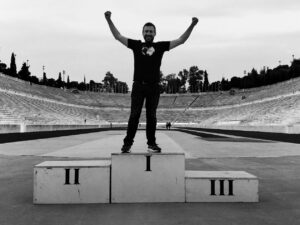
The marathon was included in the programme of the first modern Olympic Games, held in Athens in 1896. The course started in the town of Marathon and finished at the Panathenaic Stadium, covering a distance of approximately 40 kilometres.
The winner was Greek runner Spyridon Louis, who immediately became a national hero. His victory helped establish the marathon as one of the defining events of the Olympic movement.
Why Exactly 42.195 Kilometres?
The distance was not fixed definitively from the outset. In the early Olympic editions, the course varied, generally covering around 40 kilometres.
The turning point came at the 1908 London Olympics. On that occasion, the race started near Windsor Castle and finished inside the Olympic Stadium, in front of the royal box. The course measured 26 miles and 385 yards, equivalent to 42.195 kilometres.
This distance was officially standardised in 1921 and has remained the international marathon distance ever since.
The Marathon Opens Its Doors to Women
An important chapter in marathon history concerns women’s participation. In 1967, at the Boston Marathon, 20-year-old American Kathrine Switzer managed to register using her initials, K.V. Switzer, and was assigned bib number 261.
During the race, race organiser Jock Semple realised she was a woman and tried to stop her, attempting to pull off her bib. The incident was captured by photographers and made headlines around the world. Switzer managed to continue and completed the marathon, becoming the first woman to run the race with an official entry. In 1966, however, Bobbi Gibb had already completed the same race without registering.
The incident helped change attitudes towards women’s participation in long-distance running. In 1972, the Boston Athletic Association officially allowed women to enter the race. Another milestone followed in 1984, when the women’s marathon was included in the Olympic programme for the first time, at the Los Angeles Games. American runner Joan Benoit claimed the inaugural Olympic title.
Switzer’s bib number 261 has since become a symbol of this achievement, serving as a reminder of how much the marathon has changed over the years.
From Olympic Challenge to Marathons Around the World
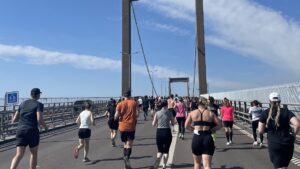
Today, the marathon is one of the most popular and recognisable events in athletics. Races take place in major capitals, small towns, exotic destinations and even extreme environments. Alongside professional athletes, millions of amateur runners take part every year, each with their own motivation.
For some, it’s about chasing a personal best; for others, it’s about pushing their limits or simply enjoying a unique experience. Over time, events that have become true running icons have also emerged, including the Abbott World Marathon Majors, a circuit bringing together some of the most prestigious marathons in the world.
The distance has remained the same, but the meaning of the marathon has evolved: from an Olympic race inspired by a legend to a sporting experience open to people of all ages and abilities. And perhaps that’s precisely what makes it so special: 42.195 kilometres are the same for everyone, but every runner has a different story to tell when they cross the finish line.